Documented Effects of Side Bet Options on Overall House Edge Calculations in Multi-Hand Blackjack Sessions
Written by Rosa Lorenz · Oct 23, 2026
Documented Effects of Side Bet Options on Overall House Edge Calculations in Multi-Hand Blackjack Sessions
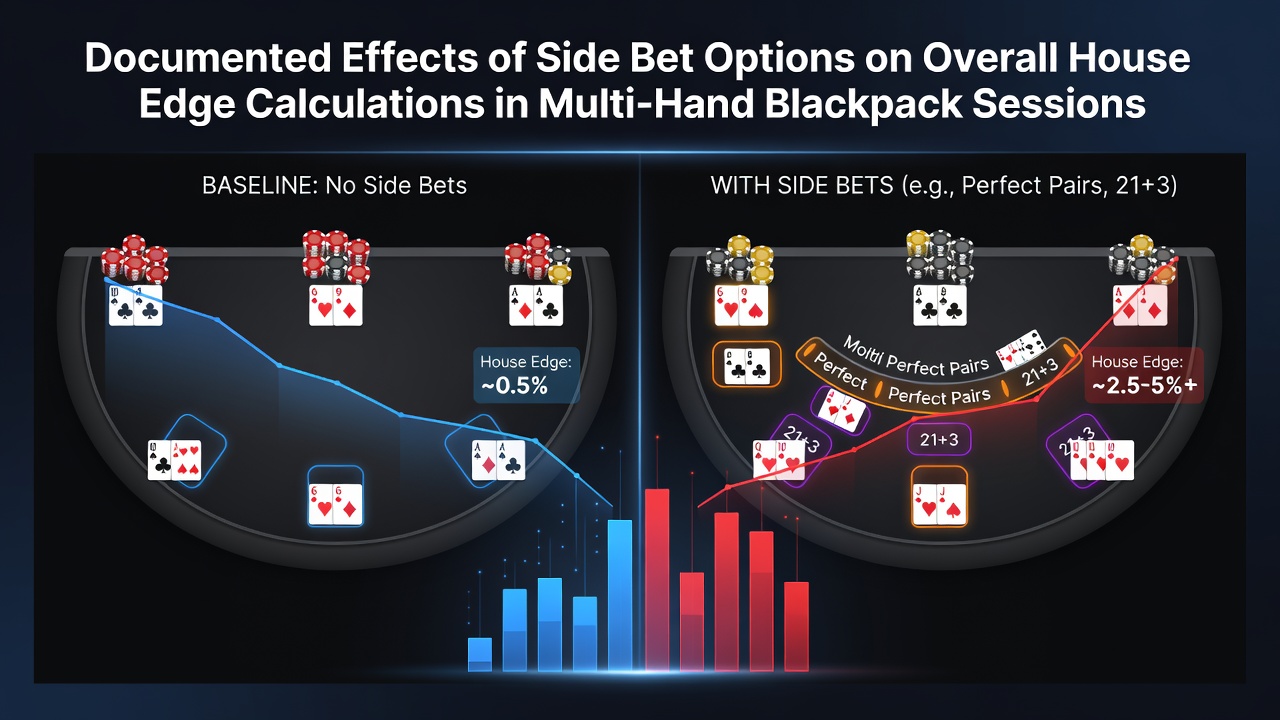
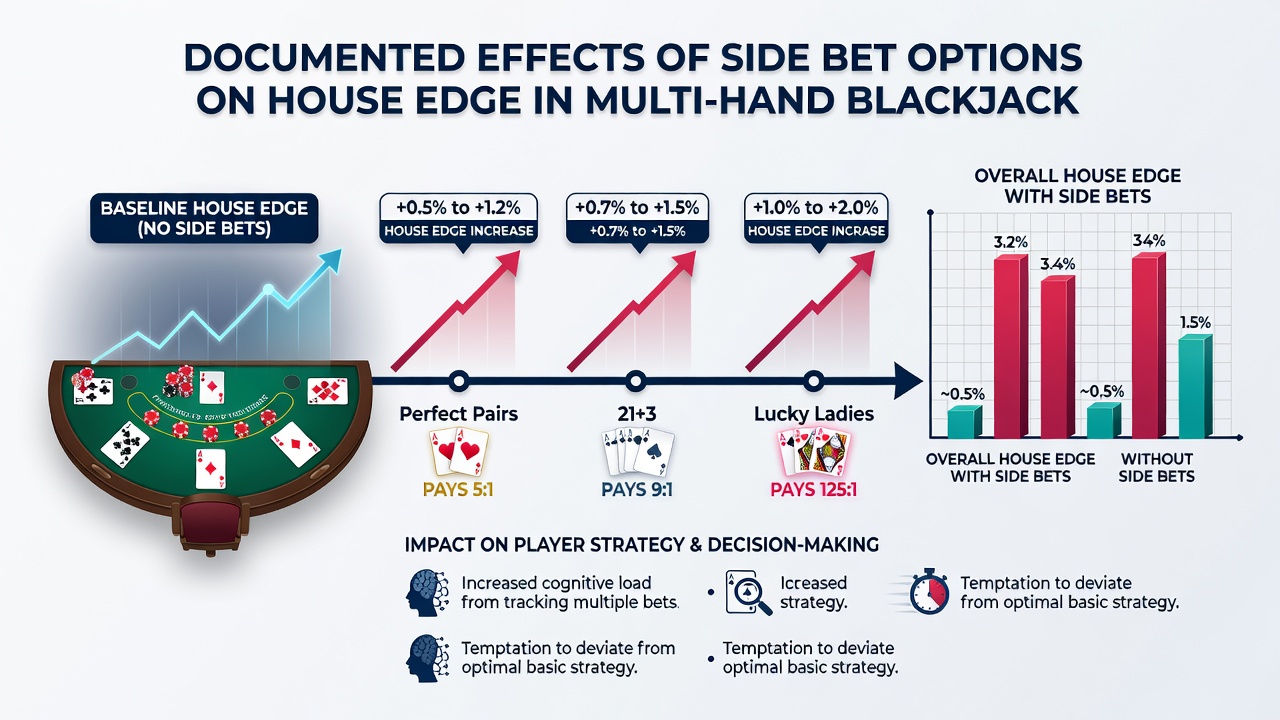
Multi-hand blackjack sessions involve players managing several simultaneous hands at one table position, and side bet options add layers that alter standard house edge calculations in measurable ways. Research indicates these optional wagers carry their own payout structures and probabilities, which compound when applied across multiple hands in a single round. Data from regulatory analyses show that side bets such as Perfect Pairs or 21+3 typically feature house edges ranging from 2 percent to over 10 percent, depending on the specific rules and pay tables in use at various venues.
Observers note that basic strategy in standard blackjack keeps the house edge near 0.5 percent under optimal conditions, yet side bets operate independently of that framework. Each side bet resolves according to separate card combination rules, and when players activate them on every hand in a multi-hand session, the weighted average house edge rises accordingly. Studies have tracked these shifts through large sample simulations, revealing consistent patterns where the overall return to player decreases as the proportion of side bet wagers increases relative to the main bets.
Core Mechanics of Side Bets and Their Separate Probabilities
Side bets function on distinct payout matrices that do not influence the primary blackjack hand resolution. For instance, a Perfect Pairs side bet pays based on whether the player's first two cards form a pair, with higher payouts reserved for suited pairs, and these odds translate directly into elevated house advantages compared with the main game. In multi-hand formats, players can place such bets on each of their concurrent hands, which multiplies the exposure without altering the underlying probabilities for any individual wager.
Evidence from probability models demonstrates that insurance side bets, triggered when the dealer shows an ace, carry a house edge around 7.4 percent in most rule sets, and this figure holds steady across multi-hand rounds because each hand's insurance decision remains independent. Researchers have documented how players who activate insurance on multiple hands simultaneously experience cumulative effects that pull the session-long house edge upward, even when main hand play follows optimal strategy.
Adjustments in House Edge Calculations for Multi-Hand Play
Calculations for overall house edge in multi-hand sessions incorporate the volume of side bet activity as a variable multiplier. Analysts apply weighted averages that factor in both the main bet edge and the higher edges from side options, then scale those figures by the number of hands played per round. Data shows that when side bets represent 20 percent of total wager volume across four simultaneous hands, the blended house edge can climb by 1.5 to 3 percentage points depending on the specific side bet types selected.
Regulatory tracking in multiple jurisdictions confirms these adjustments through reported hold percentages that exceed theoretical main-game figures when side bet participation rises. One analysis from the Nevada Gaming Control Board tracked venue-level data over extended periods and found measurable deviations tied directly to the frequency of side bet placements in multi-hand environments. These patterns emerge because each additional hand provides another opportunity to layer side wagers without changing the core deck composition or shuffle mechanics.
Documented Patterns from Extended Session Data
Longer play sessions reveal that side bet effects accumulate through repeated exposure rather than single-round variance alone. Simulation studies covering thousands of multi-hand rounds demonstrate that consistent side bet activation correlates with higher total house retention rates, particularly when players maintain the same number of hands per round throughout. Figures indicate that sessions featuring side bets on 50 percent or more of available hands exhibit overall house edges approximately double those recorded in side-bet-free multi-hand play under identical main game rules.
Additional observations from industry reports highlight how rule variations across different tables influence these outcomes. Pay table differences for side bets like 21+3, for example, shift the house edge by several percentage points, and when applied uniformly across multiple hands the variance in session results narrows while the mean return tilts further toward the house. Those who have examined aggregated player data across numerous venues note that these shifts appear consistently regardless of whether sessions occur in live dealer or automated formats.
Interactions Between Deck Penetration and Side Bet Frequency
Deck penetration levels interact with side bet frequency in multi-hand settings because deeper penetration increases the occurrence of card combinations that trigger side bet payouts. Modeling from academic sources shows that when penetration reaches 75 percent or higher, certain side bets such as suited pair options realize their theoretical frequencies more often, which in turn affects cumulative house edge calculations over the course of a session. Multi-hand players who encounter these conditions repeatedly see the documented edge adjustments materialize in shorter time frames than in single-hand play.
Further examination of distribution frequencies confirms that continuous shuffle devices, when present, reset these patterns more rapidly and can stabilize or alter the rate at which side bet outcomes contribute to overall house retention. Data collected across varied penetration depths provides clear baselines for how operators adjust theoretical hold percentages when side bet menus expand in multi-hand configurations.
Conclusion
Documented effects of side bet options on house edge calculations in multi-hand blackjack sessions rest on the independent probability structures of each wager type and their additive impact when applied across concurrent hands. Regulatory records and simulation-based research establish that these additions produce measurable increases in blended house edges that scale with participation rates and session length. Patterns identified through venue data and probability modeling continue to inform how such calculations evolve as game formats and rule sets change over time.